Future Market LabCasino hotel review desk
Independent desk, written for travellers from Finland Contact Us ENFI

Casino history

The casino hotel is not one invention. It is a chain of local answers to local rules, and the properties in our list happen to mark the main links in that chain.

Casino history

From

1824

The spa town model, Baden-Baden

The Kurhaus in Baden-Baden was completed in 1824 to designs by Friedrich Weinbrenner, with a Corinthian portico and neo-classical rooms. A casino was part of the building from the start, but its international reputation came in the 1830s, when France banned gambling and the players moved east across the Rhine. The pattern set here lasted a century: the casino was a civic building in a spa town, and the grand hotels grew around it. Brenners Park-Hotel, which opened in 1872 a few minutes away along the Oos, is a product of exactly that sequence.
From

1912

The seaside resort, Deauville

Deauville was built as a resort project rather than a town that acquired one. The casino and the Hotel Normandy both opened in 1912, the hotel designed by Theo Petit in Norman half-timbered style, the casino facing the sea a few hundred metres away. The idea was that gaming, horse racing, sea bathing and a grand hotel formed a single season. It worked well enough that the model was copied along the Channel coast and, later, the Mediterranean.

From

1930s

Neutral ground, Estoril

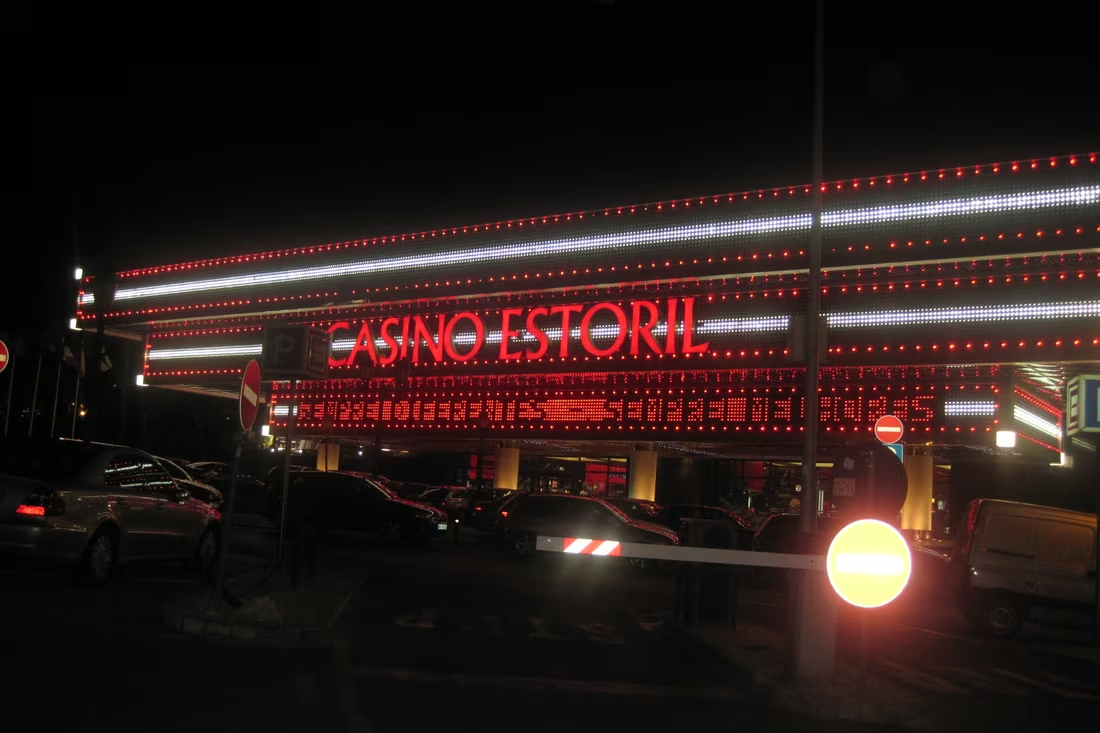
The Palacio opened in Estoril in August 1930, and Casino Estoril followed in 1931 at the head of the same gardens. During the Second World War Portuguese neutrality turned the coast into a refuge for exiled European royalty and a working ground for intelligence services from both sides, much of it conducted between the hotel bar and the casino tables. The area was known as the Coast of Kings, and the Palacio later appeared in the sixth James Bond film.

From

1966

The integrated resort, Las Vegas

Caesars Palace opened on 5 August 1966, developed by Jay Sarno and Stanley Mallin. It replaced the idea of a casino attached to a hotel with a single themed property in which the gaming floor, the restaurants, the theatre and later the shopping mall were one continuous interior. The resort now lists 3,960 rooms in six towers and about 124,181 square feet of gaming space, and the model it created was exported worldwide.

From

2010

The state-planned resort, Singapore

Marina Bay Sands opened in 2010 to a design by Moshe Safdie at a construction cost of around eight billion Singapore dollars. Singapore licensed exactly two casinos and attached conditions to them: an entry levy for citizens and permanent residents, a minimum age of 21, and an obligation to build a convention centre, a museum and a public observation deck alongside the gaming floor. The casino was treated as one component of a tourism asset rather than the point of it.

From

2003 to today

The border resort, Rozvadov

King's Resort opened on 26 June 2003 at Rozvadov on the Czech side of the German border, beside the motorway between Prague and Munich. It grew for one reason: Czech law allowed a poker operation that German law did not, and the room filled with players from across the border. By the late 2010s it held more than 160 poker tables, hosted the World Series of Poker Europe every year from 2017 to 2022, and drew over 30,000 players to the 2017 festival alone.

Casino Estoril at night
Casino Estoril. Photo: Alquiler de Coches, CC BY 2.0, via Wikimedia Commons

What the sequence shows

Every property in this list exists because of a rule somewhere else: a French ban, a Prussian closure, a wartime neutrality, a Nevada licence, a Singaporean planning condition, a German restriction. Read a casino hotel as a piece of legal geography and its layout, its dress code and even its opening hours start to make sense.

Casino Hotels